
Where your business is losing time and money (and how to fix it)
Concrete ideas for saving and earning money with apps, platforms, and artificial intelligence.
Most business owners don't know everything they could have built today. Not because it's expensive or complicated, but because it simply never crossed their mind. This page is a list of concrete things that really work in Czech companies today. And which you can picture in your own.
Don't read this as a catalog. Read it with one question in mind: Where would this save or make money for me?
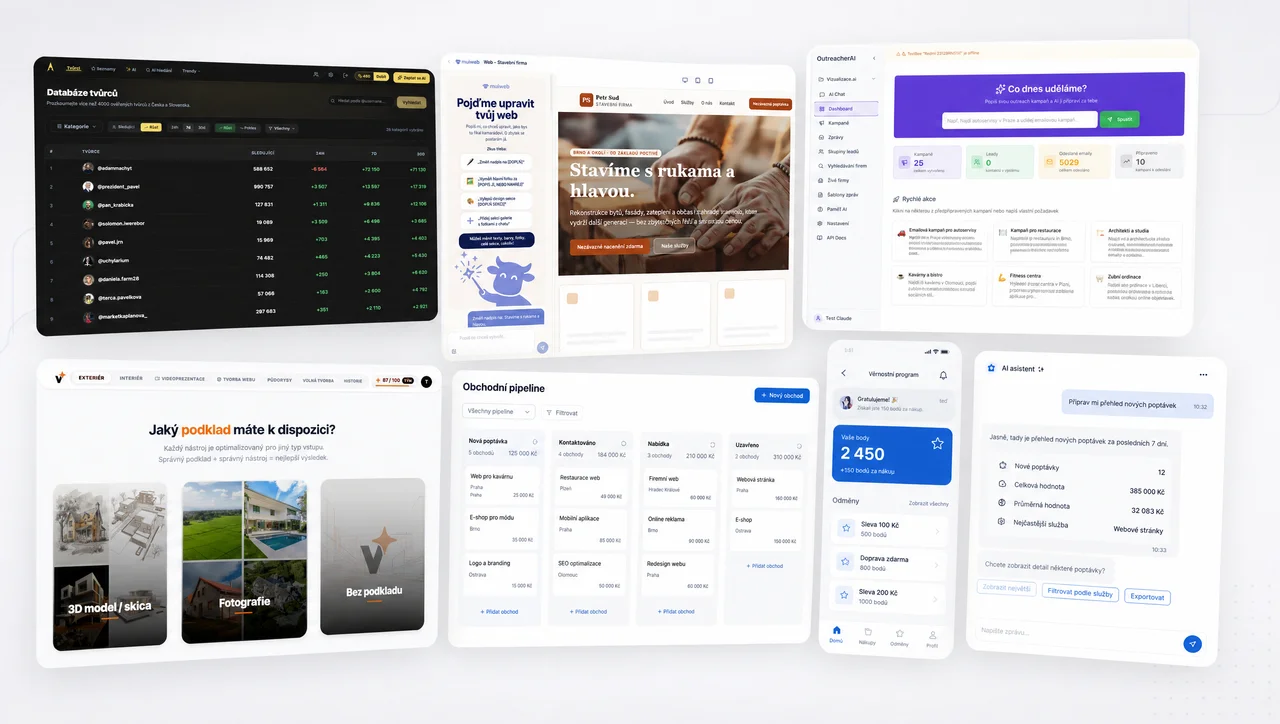
Web platform / client portal
An extension of your website where customers can log in and do something.
Think of your website as a shop window. A platform is what's behind it: a place where customers log in and do something themselves. Order, book, pay, download a document, check the status of their order. Things you handle today by phone, email, and spreadsheets, the customer now handles on their own. Anytime, even on weekends, even at night.
Simply put: a platform is an employee who works 24/7 and never has a bad day.
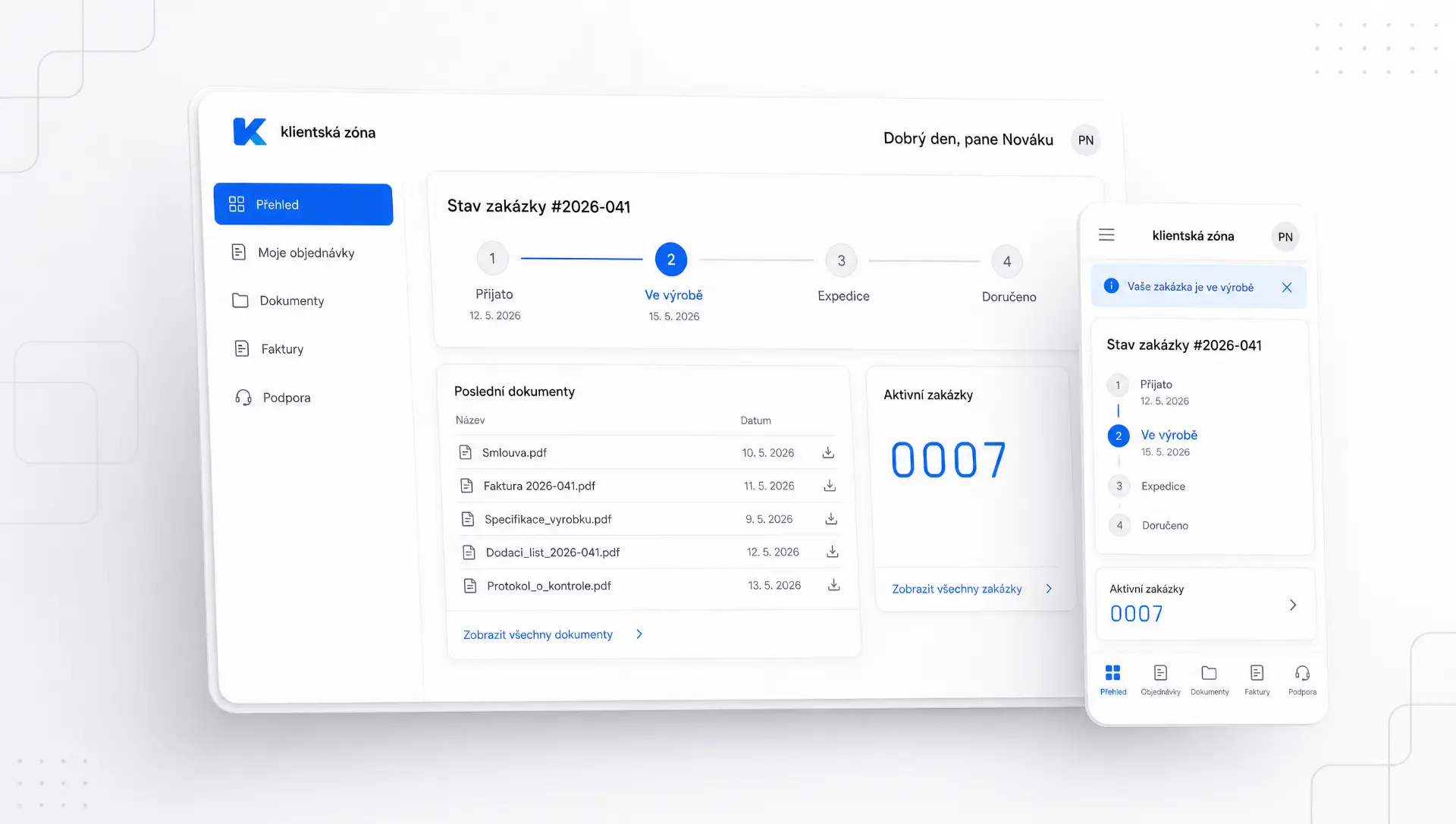
Client area
Customers log in and see their orders, documents, invoices, and order status. No more phone calls asking what stage their order is at.
- Saves hours of phone calls and emails every week
- Customers get an overview instantly, with no waiting
- You come across as more professional than the competition
Membership area with paid content
Courses, guides, and materials via subscription. A website that earns money even while you sleep.
- A new source of recurring income
- You sell knowledge you already have
- No inventory, no logistics
Custom booking system
Not a generic plugin, but bookings built exactly around how your business runs. Capacities, shifts, seasonality, advance deposits.
- No more phone calls about appointments
- Advance deposits reduce the number of no-shows
- The calendar fills up on its own, even outside business hours
Inquiry portal with a configurator
The customer clicks through what they want (dimensions, material, variants), and you receive a complete, qualified inquiry. Instead of an email asking how much a fence costs.
- Complete inquiries instead of vague questions
- You save time spent figuring out the details
- Serious buyers separate themselves from window shoppers automatically
B2B ordering portal
Wholesale partners place orders themselves, with their own pricing and order history. No phone calls, no spreadsheets emailed back and forth.
- Partners order by themselves, without taking up your time
- Fewer errors than orders placed by email and phone
- Orders come in even in the evening and on weekends
A company selling investment products came to us serving clients by email and phone. Every question about an investment's status meant 10 minutes of back-office work. We built a client portal where clients see their account, returns, and documents in real time. Result: 90% of routine questions disappeared, and the company looks a league more professional. Which matters twice as much when it comes to money.
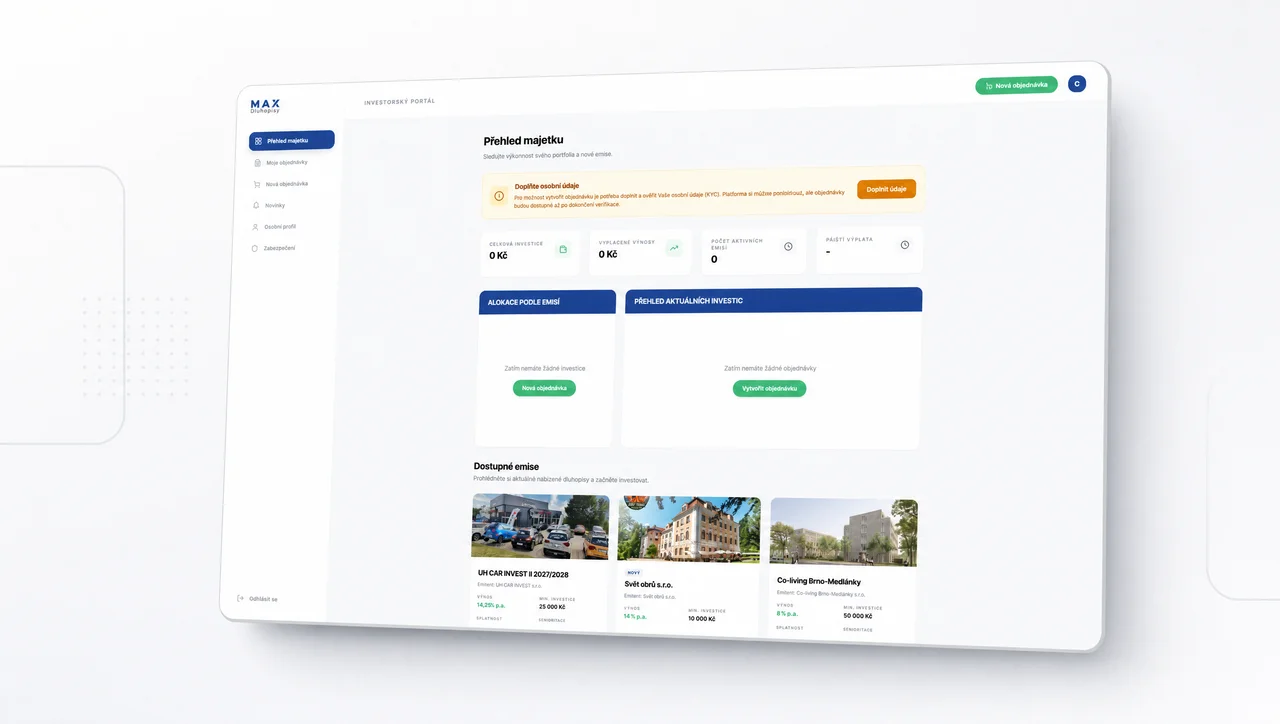
Do you have a price list, FAQ, or form on your site that still ends in a phone call anyway? That's exactly where a portal makes sense.
CRM & dashboards
All your company's numbers on one screen. Instead of five spreadsheets and a gut feeling.
Every company has its numbers somewhere: in spreadsheets, in the invoicing system, in emails, in the owner's head. The problem is that they're never all in one place. A CRM and dashboard bring this together on one screen: you see how much you're earning, which deals are moving, how each team member is performing, and where money is slipping away. Not once a month at invoicing time, but right now.
Simply put: you stop running your business from memory and start running it by the numbers.
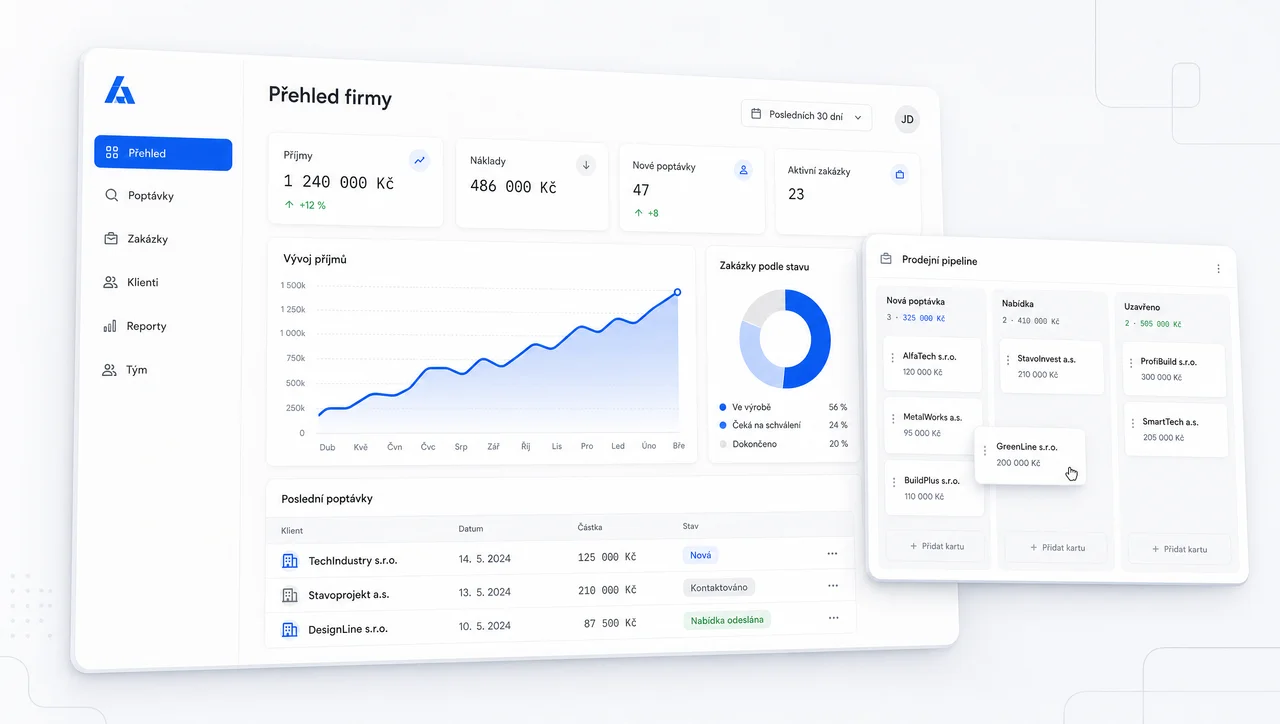
Company dashboard
Revenue, costs, margins, orders. All live in one place. Open one page in the morning and you know exactly where the company stands.
- A morning overview of your business in 30 seconds
- You spot problems right away, not at the end of the month
- You make decisions based on data, not gut feeling
CRM tailored to your process
Not an off-the-shelf tool with a hundred features you'll never use, but a system built exactly around how you sell. Every lead has its own status, and nothing falls through the cracks.
- No lead gets lost or goes cold
- New sales reps get up to speed in days, not months
- You only pay for features you actually use
Employee performance overview
Hours worked, number of calls, closed deals. Automatically, with no manual reporting.
- No more manual reporting and paperwork
- You see who's pulling their weight and where help is needed
- Fair rewards backed by numbers
Inventory and orders
What's in stock, what's ordered, what's being produced, what's been invoiced. No more digging through paperwork or asking colleagues.
- You save hours of searching and tracking things down
- Fewer mistakes, forgotten orders, and downtime
- You can find an order in a few seconds, even a year later
Data and artificial intelligence
When your data is in one place, you can ask it questions: Which product has the best margin? Which clients haven't ordered in 3 months? An answer in 5 seconds.
- Answers to questions about your business in 5 seconds
- You uncover hidden margins and dormant clients
- An analyst who never sleeps and costs nothing
For our own project, vizualizace.ai, we have a dashboard where we see everything: costs, revenue, number of users, their outputs, emails sent, and money spent on ads. One screen instead of eight spreadsheets. And for our sales team, we built a CRM that automatically adds new contacts, logs calls, and tracks hours worked. They can even discuss their performance with an AI.
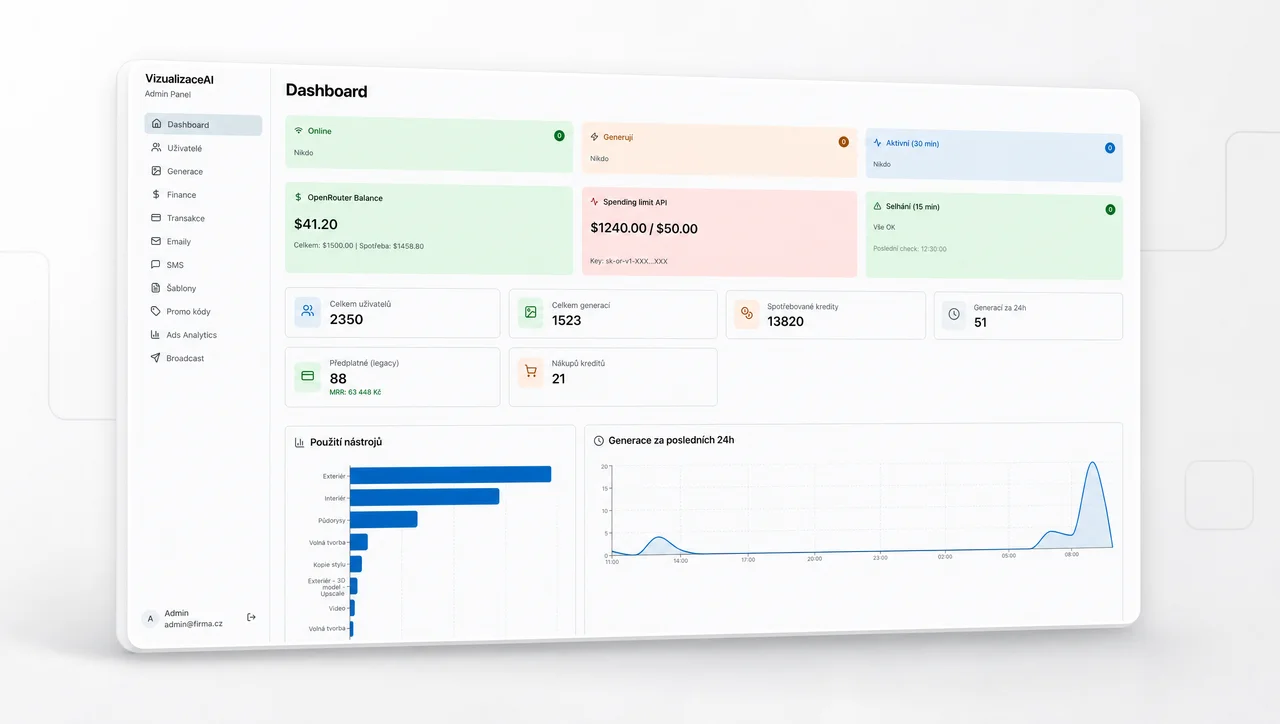
If it takes more than a minute to answer how much you've earned this year on product X, you need a dashboard. Companies that manage data in spreadsheets and on paper lose hundreds of thousands, even millions, every year. Simply because they can't see what's working and what isn't.
Custom AI tools
A small tool that does one annoying task for you. Over and over. For free.
Everyone knows ChatGPT today. But general-purpose AI doesn't know your company, your branding, or your processes. A custom AI tool is a different league: we teach it exactly the one thing someone at your company does over and over. Writing similar texts, creating graphics, copying data from documents. Instead of an hour of work, you just click and check the result.
Simply put: we take a task that slows you down and build a machine that does it for you.
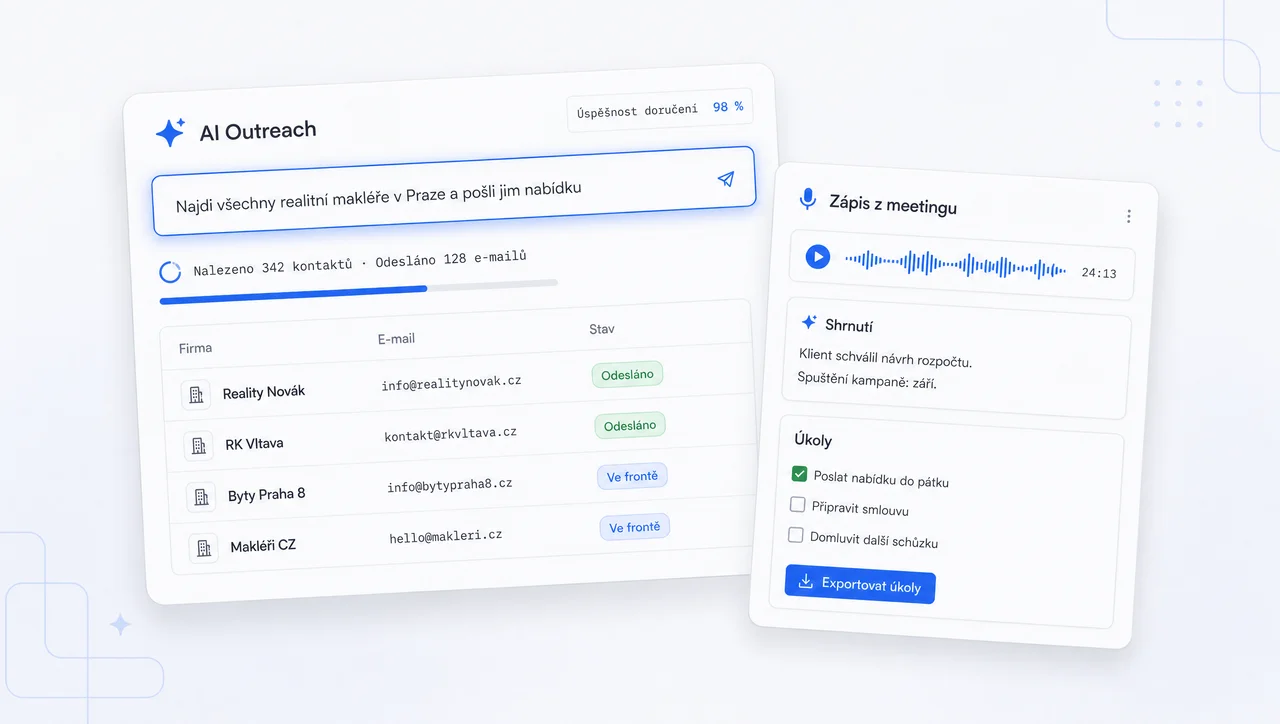
Company graphics generator
A tool that follows your branding (colors, fonts, style) and creates a post, story, or banner in a few clicks. Graphics without a graphic designer.
- Graphics in minutes, not days of waiting
- Save thousands every month on design work
- A consistent look across every output, always
Meeting transcription and analysis
Upload a recording from a meeting, and the tool transcribes it, pulls out action items, and creates an action plan. No one needs to write minutes.
- No one spends time writing meeting minutes
- No task from a meeting gets forgotten
- Your minutes are ready before you're back at your desk
An AI tool for your customers
We built vizualizace.ai, a platform where real estate agents and architects generate property visualizations using AI. The same principle works across dozens of industries. A tool that solves one specific problem for your target audience is both a product and marketing at once.
- A new product and revenue stream alongside your main business
- Attracts exactly your target audience, marketing for free
- You stand out from competitors with something no one else has
Automatic replies to inquiries
AI reads the incoming inquiry, drafts a reply in your style, and you just approve it. A response within 5 minutes instead of by the end of the day. And speed wins deals.
- A reply within 5 minutes, even outside business hours
- Speed significantly increases your chance of winning the deal
- You just approve, you don't write
Document processing
Invoices, contracts, orders. AI extracts the data and enters it exactly where it belongs. No more manual data entry.
- No more hours of manual data entry
- Fewer mistakes than manual entry
- Data ends up where you need it, instantly
We built a tool that scrapes B2B contacts from the internet and connected it to email and SMS automation. The result? Just say: Find all real estate agents in the Czech Republic and send them a personalized offer. The rest happens on its own. No manual work, no temp hire, no agency.
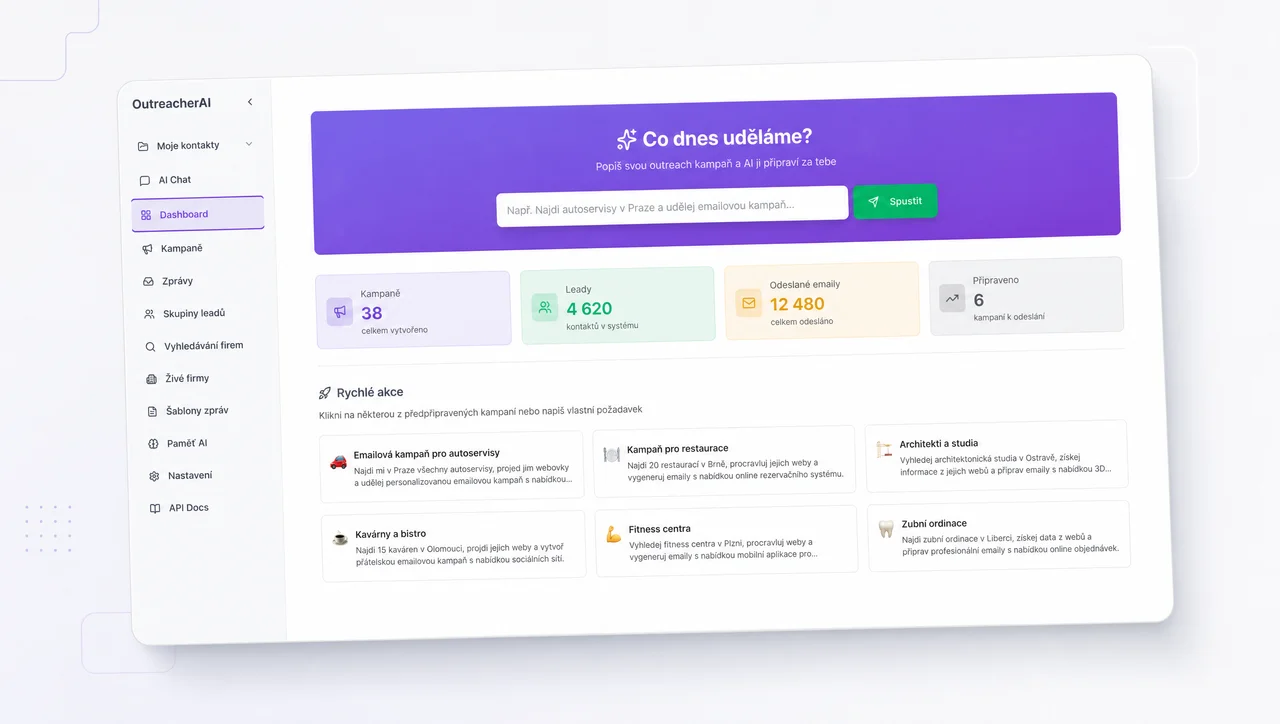
Think of a task someone in your company does the same way every week: copying data, writing similar emails, creating similar graphics. These are exactly the candidates for an AI tool that pays for itself within a few weeks.
Process Automation
Things that happen in your company by themselves. No people, no mistakes, no excuses.
Every company has activities that repeat in exactly the same way. Copying a lead into a spreadsheet, sending a confirmation, following up with a customer, issuing an invoice, sending a report. Nobody enjoys them, they take hours, and mistakes happen. Automation means we connect these steps and set them up to run on their own. Always the same way, always on time, no matter how much work you currently have.
Simply put: whatever happens repeatedly in your company doesn't need a human to do it.
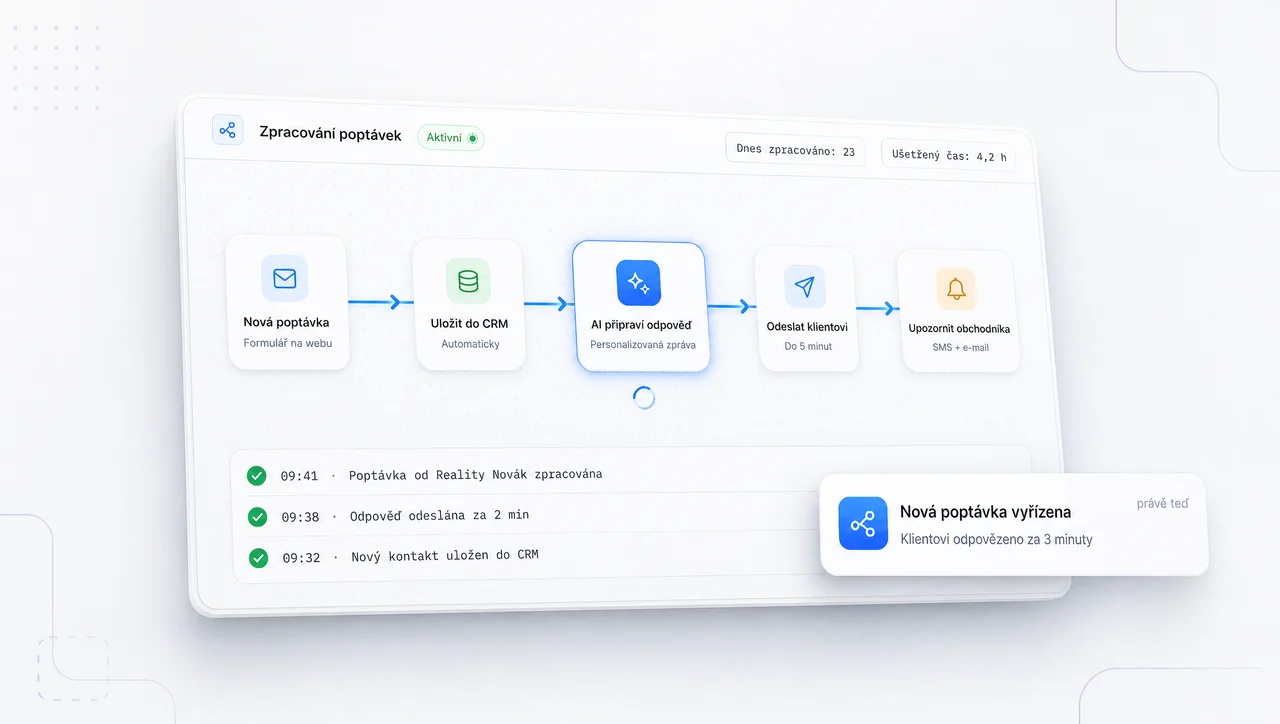
Automatic customer collection and outreach
The system finds companies in your target audience, saves their contacts, and sends them a personalized message. A sales department that runs 24/7.
- New contacts and leads arrive by themselves, every day
- Sales keep running even at night and on weekends
- For a fraction of the cost of a salesperson or agency
Follow-up that never gets forgotten
A customer inquired and never got a reply? A reminder goes out automatically after 3 days. A second one after a week. Most deals are lost right here. An automation never forgets.
- You save deals that would otherwise go cold
- A reminder always goes out, even when you're swamped
- The customer feels like you're thinking of them
Connecting systems that don't talk to each other
Order from the e-shop, invoice, warehouse, email to the customer. One process instead of four manual steps.
- One step instead of four manual ones
- No more retyping data between systems
- Fewer mistakes from carelessness and rushing
Automatické reporty
Every Monday morning you get a summary: revenue, new leads, order status. You don't have to ask anyone for it.
- A summary every Monday morning, no asking required
- Nobody spends Friday compiling spreadsheets
- You spot problems before they grow
SMS marketing
We have our own SMS sending system, which lets us offer a much lower price per message than commercial solutions. And SMS has over a 90% open rate — a channel most companies ignore.
- Over 90% of people actually open the message
- Multiple times cheaper than commercial SMS solutions
- Ideal for promotions, reminders, and quick outreach
A client was collecting leads from the website into email. When things got busy, replies were delayed by two or three days and leads went cold in the meantime. We set up automation: the lead is automatically logged into an overview, the customer instantly receives a confirmation with the next step, and the salesperson gets a notification. Nothing gets lost, no one waits.
Write down 5 things you or your people do manually every day. At least 3 of them can be automated. Do the math: 30 minutes a day is over 10 hours a month, a full working day. Times the number of people. Times 12 months.
Mobile Apps
Your business in the customer's pocket. An icon on their home screen is a daily reminder that you exist.
The average person checks their phone more than a hundred times a day. A mobile app means that among Instagram and messages, there's also an icon for your business. The customer can order, book an appointment, or collect points with just a few taps. And you can send them a message anytime that lands directly on their screen. Free, without algorithms and without paying for ads.
Simply put: an app is a direct line between you and the customer that no one can take away from you.
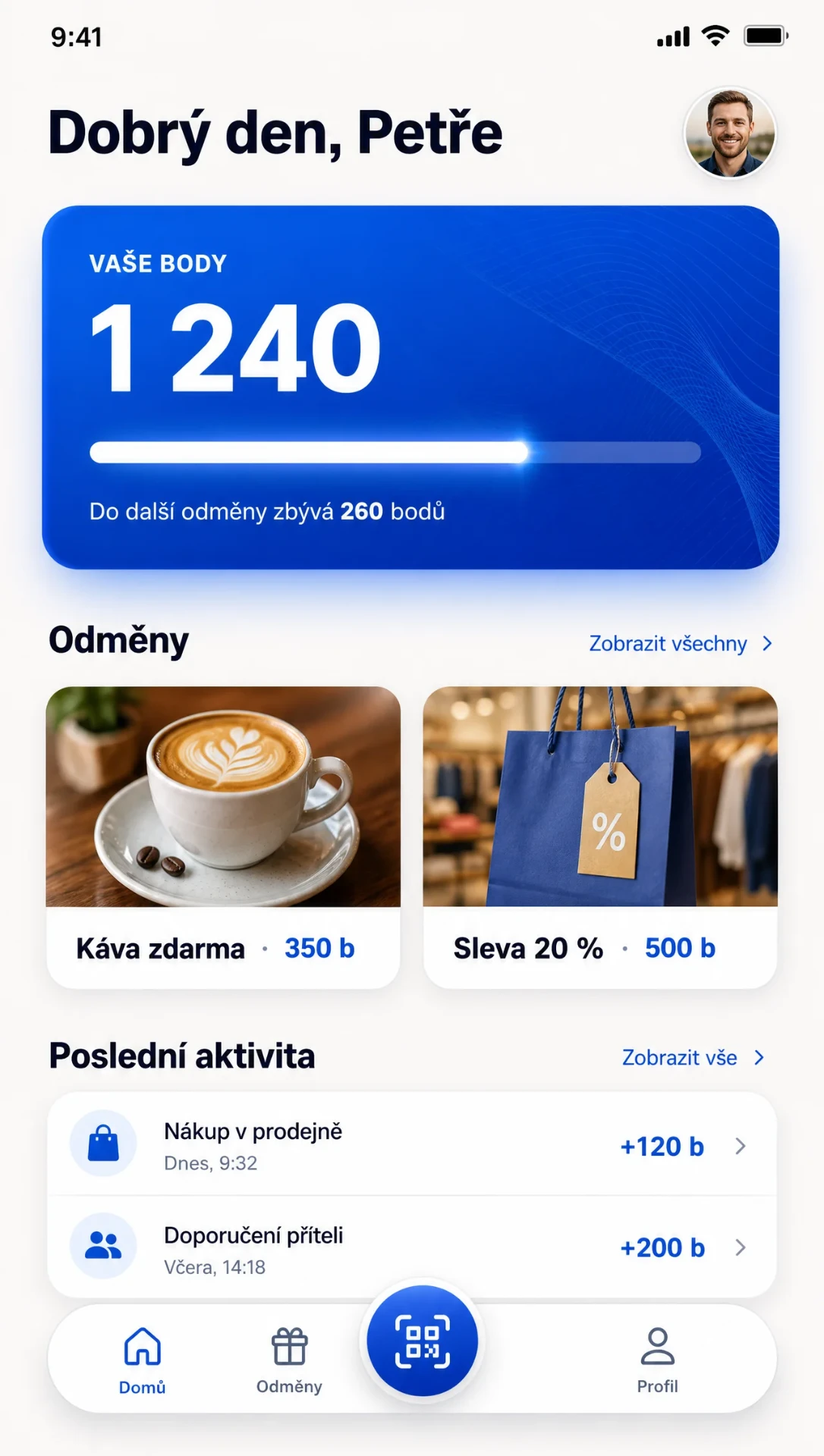
Loyalty app
Instead of paper cards, customers collect points in their phone. And you get their contact, purchase history, and the ability to send them free notifications.
- Customers come back more often and spend more
- You have contacts and purchase data in one place
- Reach your entire database for free, anytime
Push notifications instead of paid ads
A message like "Fresh croissants today until 10:00" sent to 2,000 people costs 0 Kč. The same reach on Instagram would cost you money.
- Zero cost to reach customers
- The message lands directly on the screen, not in an algorithm
- Ideal for promotions, news, and quick clearance sales
Orders and payments right in the app
The customer orders in 3 clicks. Fewer steps mean more orders.
- More orders thanks to fewer steps
- The customer pays with a card saved in their phone, no barriers
- Orders come in automatically, no phone calls or staff needed
The app as part of the service
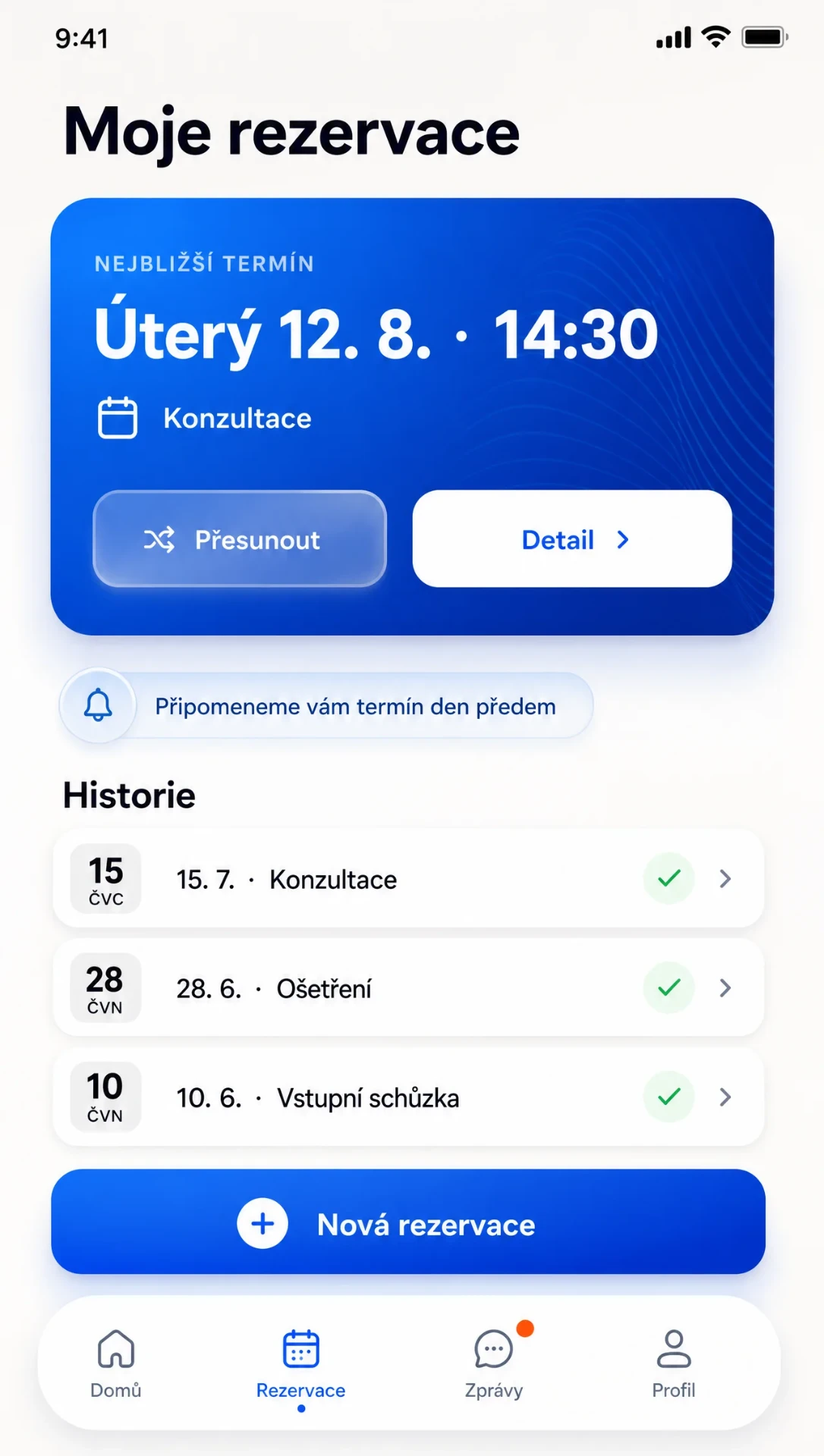
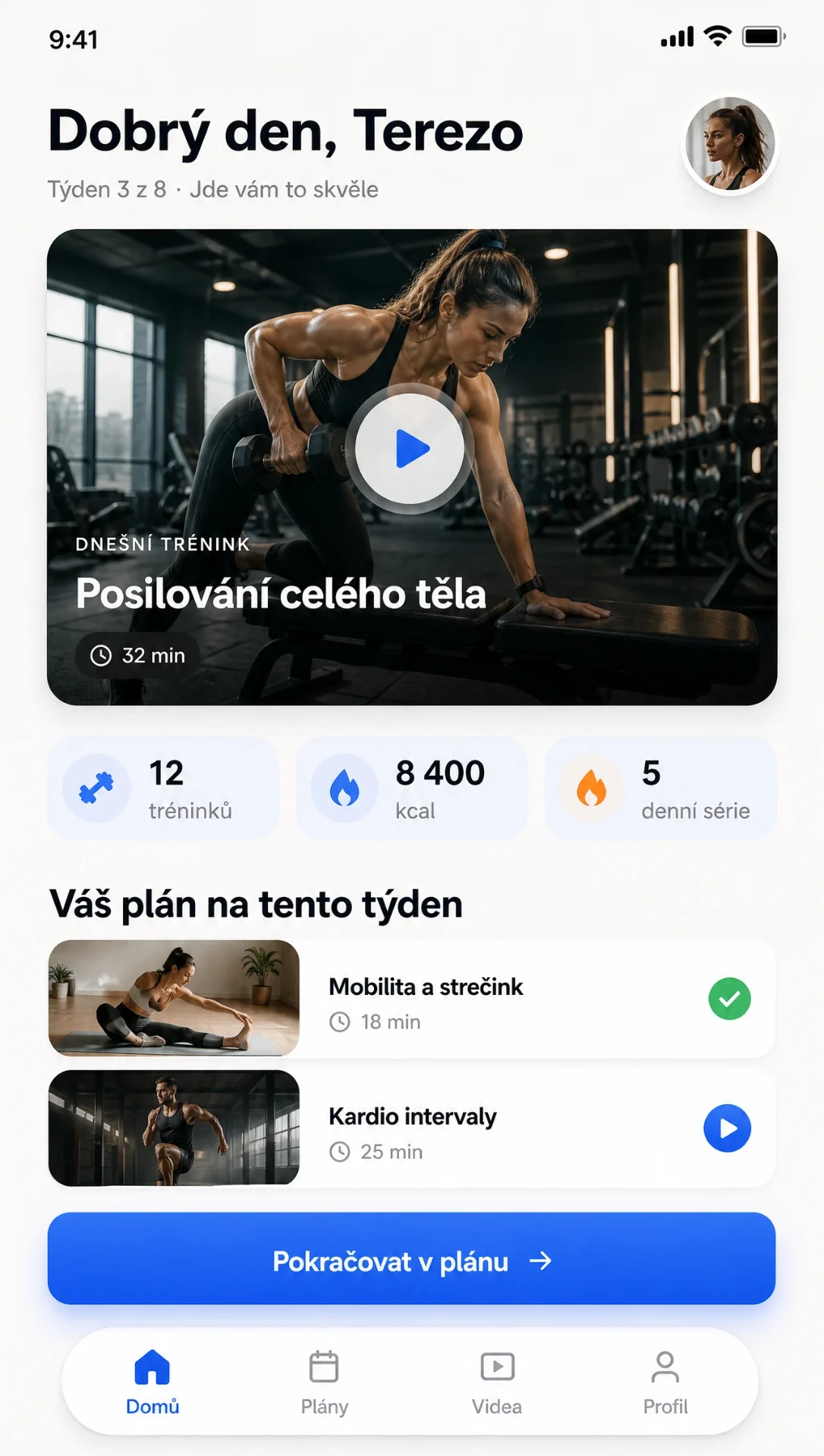
A fitness studio with training plans in the app, a clinic with appointment reminders, a car service with vehicle history. The customer gets extra value and has no reason to switch to a competitor.
- The customer gets extra value competitors don't offer
- Fewer missed appointments thanks to reminders
- A stronger relationship means longer-lasting business
The app as a new business
Have an idea for an app? We handle the whole process from concept through design to publishing on the App Store and Google Play.
- From idea to App Store with a single partner
- Save months of searching for developers and designers
- Your own product that can earn money on its own
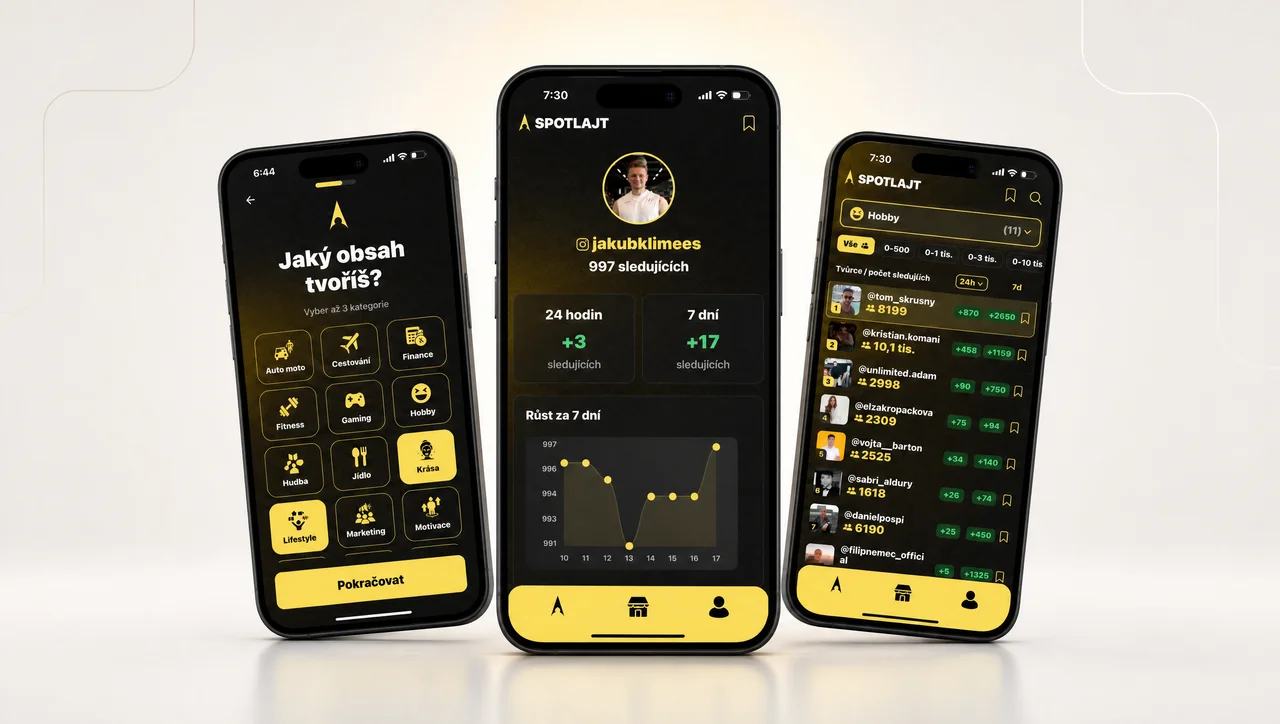
We built our own app, Spotlajt, a social network that tracks the growth of Instagram content creators. From idea to a published app in the stores. Why we mention it: every app we build for clients gets the same care as our own product that we earn money from.
An app makes the most sense where customers come back. If people buy from you repeatedly (food, services, memberships), the app pays for itself quickly.
AI agenti
The newest league. Not a tool, but a digital colleague.
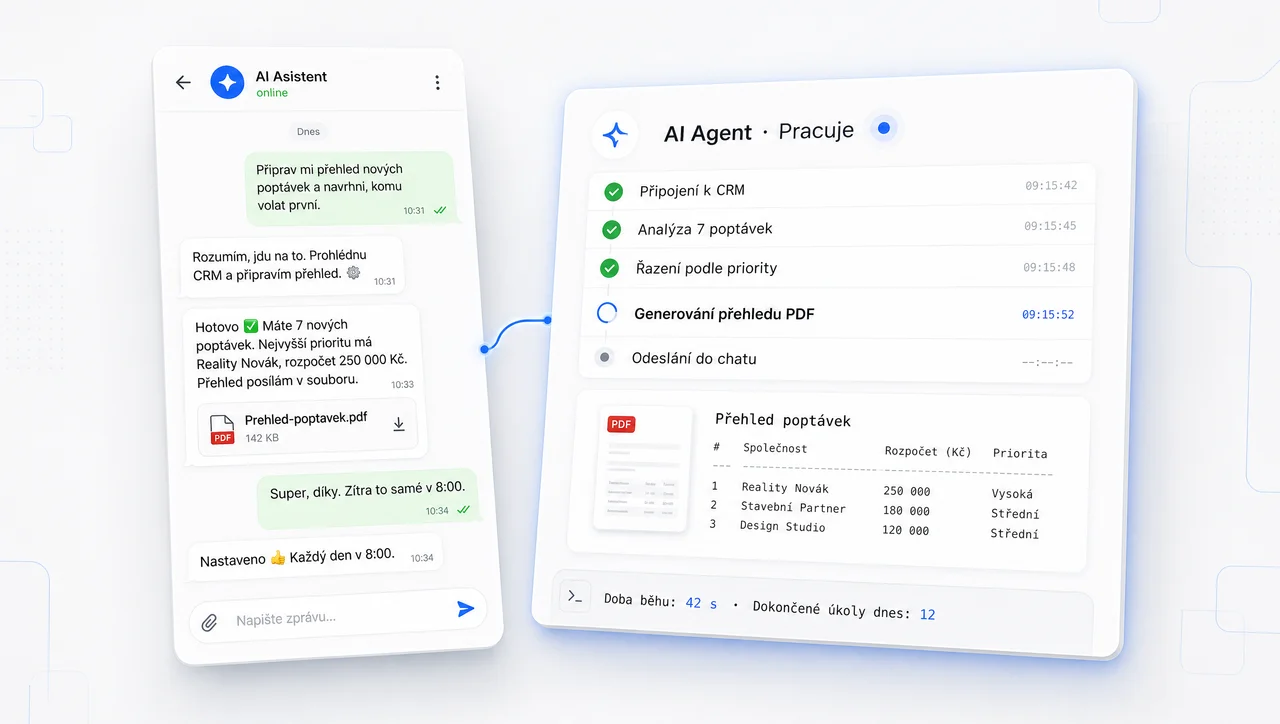
A tool waits for you to use it. An agent works on its own. An AI agent is a system you assign a task to in plain language, say via WhatsApp or Telegram, and it completes it independently. It finds information, prepares materials, writes emails, processes data. If it's unsure, it asks. When it's done, it lets you know. And tasks you give it once, it can repeat every day on its own.
Simply put: an agent is a colleague you message in the morning, and it handles the rest.
We build and set up agents to your specifications, for any repetitive task you'd rather not do yourselves. This is technology used today by only a fraction of Czech companies. In two years, it will be standard.
Those who start early will gain a lead that's hard to catch up to.
Where to start: 3 questions for your business
You don't need to know right away what to build. Just answer three questions honestly:
What do we do manually and repeatedly?
A candidate for automation or an AI tool.
Where do we lose track? Of data, orders, customers?
A candidate for a dashboard or CRM.
What do customers keep asking for that we handle by phone and email?
A candidate for a portal or app.
If any of these questions brought a specific situation at your company to mind, you've just found a place where technology can make or save you money.
What's next
Every business is different. What makes sense for a bakery doesn't make sense for a law firm. That's why we don't start with a proposal, but with a conversation. Tell us what came to mind as you read this, and we'll tell you whether and how it makes sense to build.
We choose the projects we want to work on. But the first consultation is free. And you'll leave it with at least a clearer picture of where your business has the most potential.